Underground Utility Mapping (PAS 128)

Underground utility mapping provides crucial insights into the hidden infrastructure beneath our feet, preventing damage and ensuring safer construction and maintenance.

Long black pipes run along a deep trench.

What is underground utility mapping (PAS 128)?

PAS 128 is the UK standard for underground utility mapping, offering a structured methodology to detect, verify and record buried services such as gas pipes, electric cables, water mains, sewers and telecoms. Its primary aim is to mitigate the risk of damage to underground infrastructure during construction or excavation.

PAS 128 surveys assign a confidence level to each detected utility, from D (lowest) to A (highest):

  • D – Desktop survey: Collation and review of existing records and plans
  • C – Site reconnaissance: Visual inspection of the surface for signs of utilities
  • B – Detection survey: Use of geophysical techniques (GPR, EML and RFL) to locate and map services
  • A – Verification survey: Physical exposure or ‘daylighting’ of the utility to confirm its position

Why is PAS 128 important?

PAS 128 underpins safe and efficient construction by standardising survey methods—desktop research, GPR, EML, radio-frequency locating (RFL), visual inspection and record-plan –integration to:

  • Prevent utility strikes through accurate location data
  • Ensure consistency by following a recognised confidence-level framework
  • Improve planning by providing reliable service layouts for designers and contractors
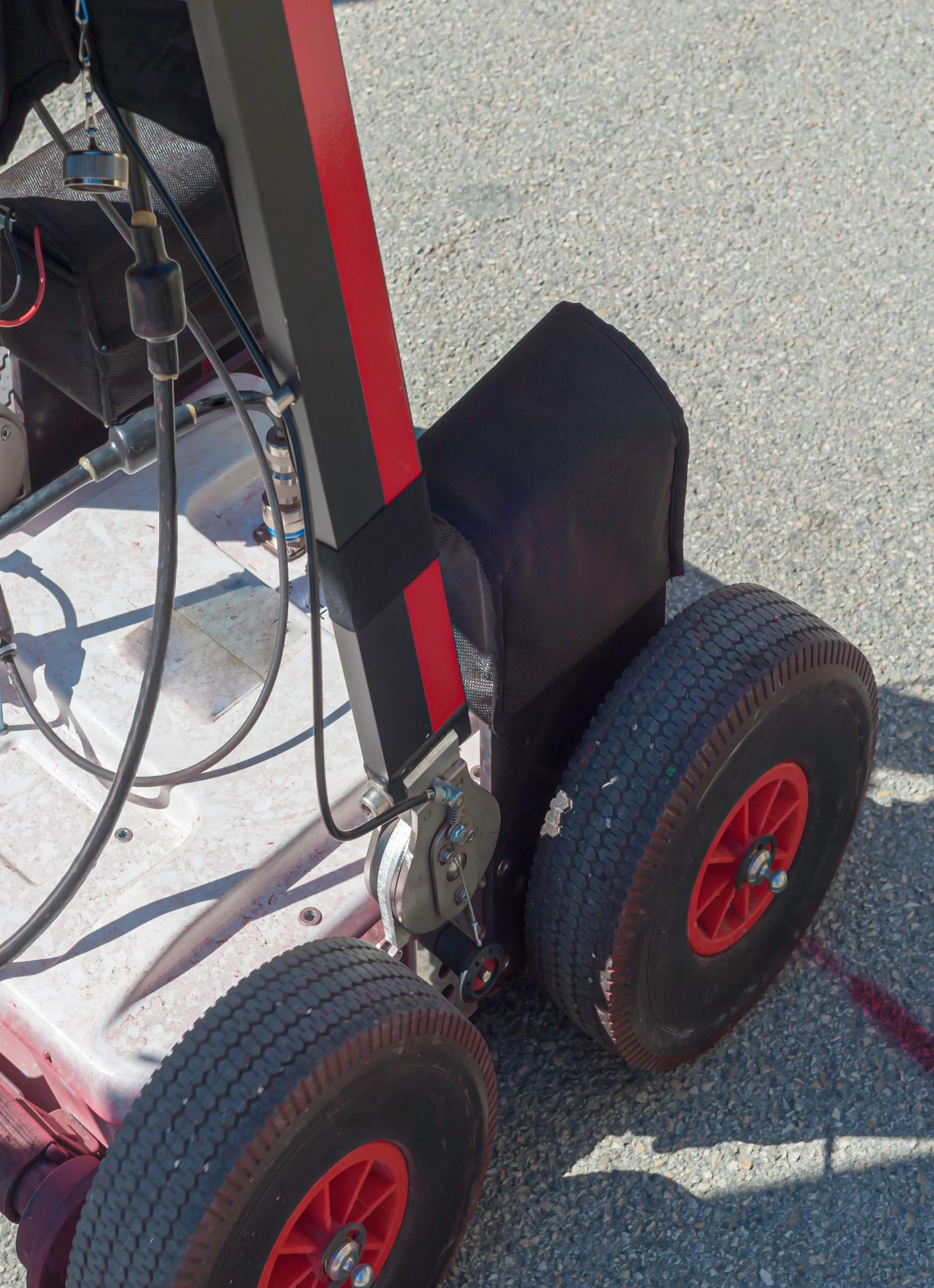
Ground penetrating radar device being used to map utility pipes underground.

Why choose Academy Geomatics?

We employ a comprehensive suite of technologies to accurately pinpoint buried gas pipes, electric cables, water mains, telecommunications lines and other essential assets. These include:

  • Ground Penetrating Radar (GPR): Sends radio waves into the ground; reflected signals from objects (such as pipes or cables) are interpreted for location data
  • Electromagnetic Location (EML): Uses a transmitter and receiver to detect electromagnetic fields emitted by underground cables and pipes
  • Radio Frequency Locators (RFL): Employs radio signals to trace metallic utilities at depth, offering greater reach than standard electromagnetic methods

By delivering accurate and reliable underground utility information, we support informed infrastructure planning, enhance on-site safety and contribute to more efficient and cost-effective project delivery.

Get in touch

Innovative surveying solutions

Your trusted partner for accurate spatial measurement and analysis across a wide range of applications, from land-boundary surveys to structural-health assessments.

View all services

Showcasing our expertise

Discover our most recent land surveying projects. These case-studies demonstrate precise, efficient solutions to complex challenges.

Trusted by industry partners

WSP
Jacobs
ESH Group
Northumbrian Water Living Water
Stantec
Bowmer Kirkland
Environment Agency
Royal Haskoning DHV
NHS
Atkins Realis
WSP
Jacobs
ESH Group
Northumbrian Water Living Water
Stantec
Bowmer Kirkland
Environment Agency
Royal Haskoning DHV
NHS
Atkins Realis
ISO 9001 Certification.
ISO 14001 certification.
ISO 45001 Certification.
SSIP
The Survey Association
Move Solutions
Chartered ICES logo
Construction gold member
SafeContractor Approved